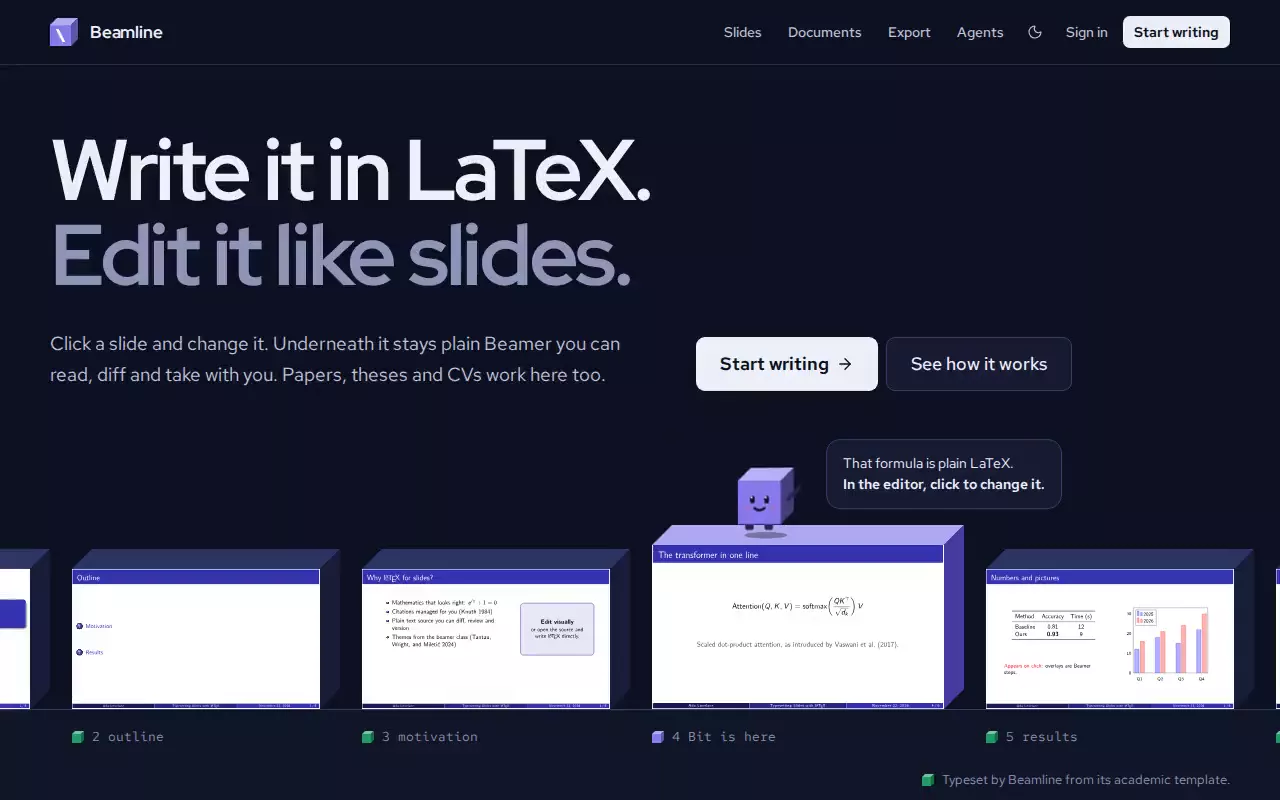
A LaTeX editor for any document: papers, theses, reports, CVs and slides. A Beamer deck opens on a canvas where you drag, resize and type like in PowerPoint, and every edit rewrites only the lines it touches, so the source stays the LaTeX you wrote.
Builds are incremental, with errors shown on the right file, line and slide. Decks export to PDF, editable PowerPoint or an Overleaf-ready zip, and agents can work on the same project over MCP while you watch.
Slides in LaTeX look right and live well in version control, but nudging a box means guessing coordinates and recompiling. Slide editors are the other way round. Beamline keeps the LaTeX and puts a canvas on top of it.
02The source is the truth
There is no second model to keep in sync. The canvas is parsed from the main file every time, and a visual edit splices only the text it changes, so hand-written LaTeX is never reformatted. Edits made at the same time, such as you typing while an agent works, are merged three ways, and every change is kept in a history that records who made it.
03Compiling someone else’s TeX safely
TeX can read files, so every build runs in a sandbox that confines it to its own project with Landlock. The production image refuses to compile at all when the kernel can’t enforce that, rather than run a build unconfined.
04Agents check their own work
Over MCP an agent can open a project, edit files or slide elements, compile and get errors by file and line, and render a page or a slide to an image to look at what it made. Its edits appear live in any editor that has the project open, under its own name.
Ask Wick
Answers from this site, David’s GitHub and his press
Hi, I’m Wick. I run on the same server as David’s projects, so I’ve watched most of them get built. Ask me anything about him.
AI answers can be wrong; the linked pages are the source. Questions aren’t stored.